The Music of India
I am a practicing Hellenic polytheist and we have a deity for just about everything, so I’m always curious about other religions and their deities. I searched and discovered Saraswati, the Hindu goddess of music(and also knowledge, art, and speech). She’s usually depicted holding a veena, and I’ll talk more about that in a moment. Sometimes she’s shown with four hands, which represent manas (mind, sense), buddhi (intellect, reasoning), citta (imagination, creativity), and ahamkāra (self consciousness, ego).She’s usually seen with a hamsa, a swan or goose, which is a sacred bird in Hindu mythology. In Japan, she’s known as Benzaiten and is typically shown played a Biwa, which is a Japanese short-necked lute. Here is a morning prayer dedicated to Saraswati.

A veena is a stringed instrument, however there are some specific veenas. The God Shiva is said to have created the Rudra Veena, the most difficult of the veenas. It is a is a fretted veena with two large equal size resonators below a stick zither.

The Saraswati Veena is named for the goddess Saraswati and is a plucked veena. It’s used more in South India for carnatic music. It looks similar to the rudra veena but with one resonator instead of two.
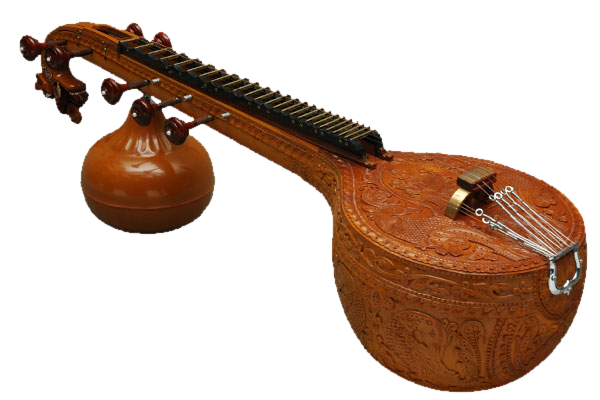
There are many more veenas, such as the sitar, the chitra veena, and the kinnari veena. The kinnari veena has three gourds acting as resonators.
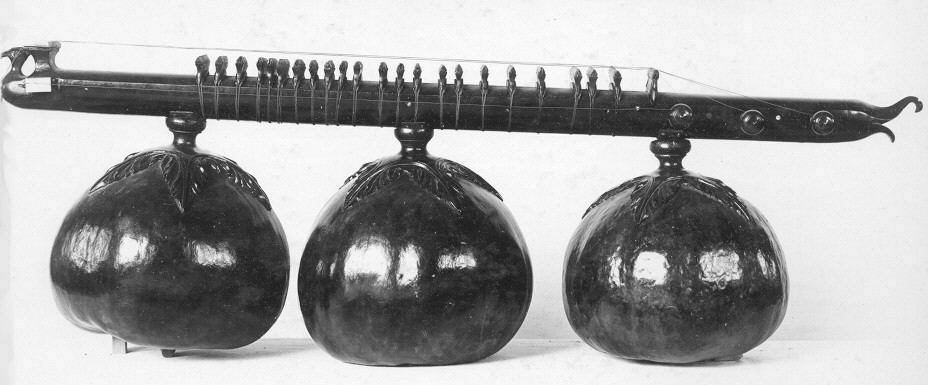
The veenas all typically bear a resemblance to one another but each has something special about it that makes it unique from the others.
I also came across Narada, a god-sage and one of the children of Brahma, who is Saraswati’s husband. Narada is a traveling musician who plays the kartal and the ektara. Traditionally, the kartal is a hand instrument composed of wooden blocks and jingles. Kartal means “rhythm of the hands” and the instruments used vary. Here is someone playing the kartal and teaching about it. The ektara is a one stringed instrument made from a gourd with a bamboo neck. Here is someone playing the ektara.This man plays both the ektara and the kartal, just as Narada would have.
Cartwright, M. (2015, November 25). Saraswati. World History Encyclopedia. Retrieved January 23, 2022, from https://www.worldhistory.org/Sarasvati/#:~:text=Saraswati%20(also%20Sarasvati)%20is%20the,is%20the%20goddess%20of%20speech.
(2012, June 22). Wayback Machine. Retrieved January 23, 2022, from https://web.archive.org/web/20140908043058/http://www.smtagorecentre.com/Repository/category/musical-instruments/


Hi Jillian! It was nice to come and see that you did further research on the things that we learned just today in class. The veena actually reminds me of a lap steel guitar and I also found it interesting that even with his small street performance he still used a drone with the one stringed instrument so that just goes to show how important the drone is in their music.
ReplyDeleteThanks for doing more extensive research on this stuff! I am a Christian, but I think the other religions are so interesting and I love learning about them. I enjoy the connections between the gods and the stories that are told that create these connections. I also really enjoyed the first song in this blog, it was really soothing, but also really intriguing to listen to with the sitar being played.
ReplyDeleteThank you for sharing more about the instruments and religious aspects of the culture. It's always interesting for me to learn about other religions in the world, and I was so excited to learn about Buddhism, Hinduism, and Muslim beliefs and traditions.
ReplyDelete